


TL;DR: Over 15.4 million UK residents experience hair loss, with male pattern baldness affecting 6.5 million men (95% of male cases). Early intervention with clinically proven treatments like finasteride (99% prevention rate) and minoxidil (62% regrowth rate) produces significantly better outcomes than waiting. Hair loss is genetic (80% hereditary), caused by DHT hormone sensitivity, and creates substantial psychological impact—but evidence-based treatments can prevent progression and restore growth.
What You Need to Know About Male Hair Loss:
- Male pattern baldness affects 95% of men experiencing hair loss—it’s predictable and treatable
- By age 35, 40% of men show significant hair loss; 25% of men in their twenties already seek treatment
- Finasteride prevents hair loss in 99% of men; minoxidil produces regrowth in 62% after one year
- Early treatment is critical because once hair follicles stop producing, reversal becomes exponentially harder
- Advanced treatments like PRP therapy and new clascoterone solutions show up to 539% improvement versus placebo
How Common Is Male Hair Loss in the UK?
Over 15.4 million people across the UK currently deal with hair loss. That’s nearly one in four people—not a small problem hiding in the shadows.
Here’s what the data shows: 6.5 million men specifically face male pattern baldness, which accounts for 95% of all male hair loss cases. This isn’t a mystery condition. It’s the most common cause, and it follows predictable patterns.
Bottom line: Male pattern baldness is the dominant form of hair loss in UK men, affecting millions in predictable, treatable patterns.
When Does Male Hair Loss Typically Start?
By age 35, approximately 40% of men already show significant hair loss. By age 50, that number climbs to 30-50%.
The data reveals something critical: 25% of men in their twenties already show signs and actively seek treatment. They’re not waiting or hoping it goes away. They’re taking action early because they understand something important.
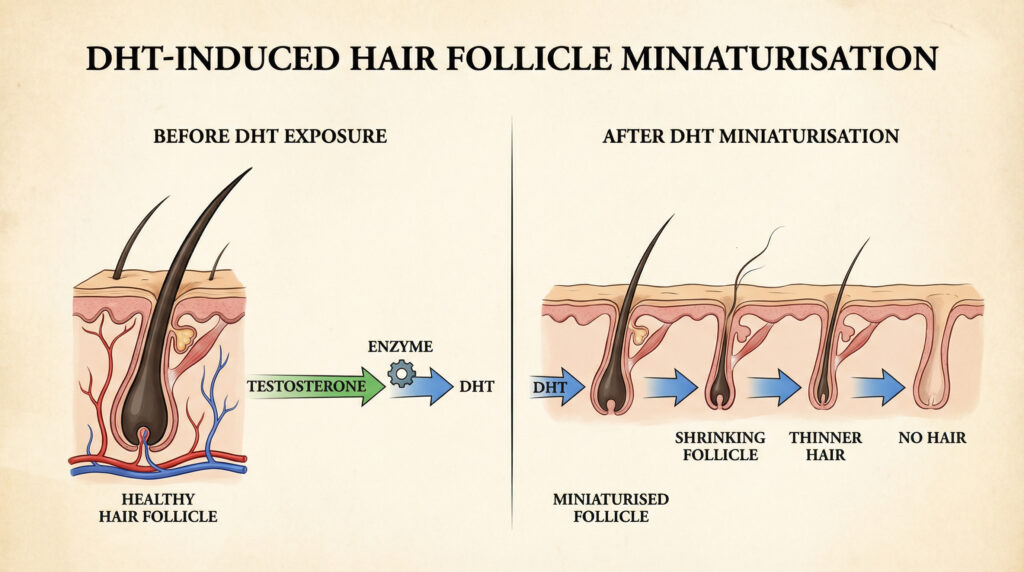
Once hair follicles miniaturize and stop producing hair, reversal becomes exponentially harder.
The reality: Hair loss progression accelerates with age, making early intervention the most effective strategy for preservation and regrowth.
What Is the Psychological Impact of Hair Loss?

More than 25% of men find hair loss “extremely upsetting.” Another 65% report moderate to severe emotional distress. These aren’t vanity concerns—patients describe their diagnosis as “devastating” and “traumatizing.”
Clinical studies show men with androgenetic alopecia experience:
- Anxiety and depression
- Decreased confidence in social situations
- Avoidance of family occasions
- Career-related concerns
Why this matters: Hair loss creates measurable psychological distress that affects daily life, relationships, and professional confidence—not superficial vanity.
What Causes Male Pattern Baldness?
You’ve probably heard the myth: “Check your mother’s father. That’s your future.” The science tells a different story.
Recent research identified over 250 independent genetic loci associated with severe hair loss, with 63 genes playing a role. Approximately 80% of bald men have bald fathers. Genetics account for roughly 80% of predisposition.
The mechanism: Male pattern baldness results from hair follicle sensitivity to dihydrotestosterone (DHT), a hormone derived from testosterone. DHT shrinks hair follicles and shortens the hair growth cycle over time.
Key insight: Hair loss is 80% genetic and caused by DHT sensitivity—it’s not your fault, but you’re not powerless because effective treatments target this mechanism.
Which Hair Loss Treatments Actually Work?

Finasteride: Prevents hair loss in up to 99% of men and produces new hair growth in two-thirds of users. Clinical studies show 66% of men experienced hair regrowth after two years on finasteride, compared to just 7% on placebo.
Minoxidil: 62% of men experience hair regrowth in affected areas after one year of using 5% minoxidil.
Clascoterone: In December 2024, breakthrough research revealed that topical clascoterone 5% solution achieved up to 539% relative improvement in hair count versus placebo. This represents the first novel mechanism of action in over 30 years.
Evidence summary: Finasteride, minoxidil, and clascoterone are clinically validated treatments with measurable success rates in controlled studies—not marketing claims.
What Advanced Treatments Are Available Beyond Medications?
Platelet-rich plasma (PRP) therapy enhances hair density and thickness with a favorable safety profile. Clinical trials showed patients achieving up to 66.8% reduction in hair loss and up to 32.5% increase in hair growth.
PRP protocol typically involves:
- Three initial monthly treatments
- Maintenance every 3-6 months
- Combination with other therapies for enhanced results
Other advanced options: JAK inhibitors show 65-70% of patients experiencing significant scalp hair regrowth in alopecia areata cases. Low-level laser therapy, stem cell treatments, and combination approaches provide multiple pathways to restoration.
What this means: Regenerative treatments like PRP offer clinically proven alternatives or supplements to traditional medications, with measurable improvements in hair density and growth.
How Has Demand for Hair Loss Treatment Changed?
Search interest in finasteride rose 95% between 2020 and 2025 in the UK. Minoxidil search interest increased over six times between 2016 and 2025. The UK hair loss treatment market is valued at approximately £3.67 billion.
Cultural shift: Modern men no longer accept hair loss silently. They’re seeking professional solutions and investing in their confidence because treatment is now normalized and expected.
Why Does Early Treatment Matter?
The earlier hair loss begins, the more severe it typically becomes. Men who act early have significantly better outcomes because they’re treating follicles that are still active and responsive.
Clinical outcomes consistently show this pattern: men who wait until hair loss is advanced face a harder battle. Men who intervene early preserve more of what they have and see better regrowth results.
Critical takeaway: Timing determines treatment success—active follicles respond far better than dormant ones, making early intervention the single most important factor in outcomes.
What Should You Do If You’re Experiencing Hair Loss?
If you’re noticing thinning, a receding hairline, or increased shedding, you’re facing a decision point. You can wait and hope it stabilizes on its own, or you can consult with specialists who understand the full spectrum of evidence-based treatments available today.
At Shumaila’s Clinic, we approach male hair loss with the clinical rigor it deserves. We don’t offer false promises or one-size-fits-all solutions. We assess your specific pattern, understand your genetic predisposition, and develop treatment protocols based on what clinical evidence shows actually works.
Our approach combines proven pharmaceutical treatments, advanced regenerative therapies like PRP, and ongoing monitoring to adjust protocols based on your response.
The 15.4 million people in the UK dealing with hair loss have taught us one thing: early intervention with evidence-based treatments produces the best outcomes.
Frequently Asked Questions About Male Hair Loss
Is male pattern baldness reversible?
Male pattern baldness can be slowed, stopped, and partially reversed with treatments like finasteride and minoxidil. However, once follicles are fully dormant, regrowth becomes extremely difficult. Early treatment yields significantly better reversal results.
How do I know if my hair loss is genetic or temporary?
Genetic male pattern baldness follows predictable patterns (receding hairline, crown thinning) and progresses gradually. Temporary hair loss (telogen effluvium) occurs suddenly after stress, illness, or medication changes and typically resolves within 6-9 months. A specialist consultation provides definitive diagnosis.
What’s the success rate of finasteride for hair loss?
Finasteride prevents further hair loss in up to 99% of men and produces new hair growth in approximately 66% of users after two years. It works by blocking DHT, the hormone that shrinks hair follicles.
Are there side effects from hair loss medications?
Finasteride and minoxidil have well-documented safety profiles. Finasteride may cause sexual side effects in 1-2% of users, which typically resolve after discontinuation. Minoxidil can cause scalp irritation in some users. A medical consultation assesses your specific risk factors.
How long does it take to see results from hair loss treatment?
Minoxidil typically shows results within 4-6 months. Finasteride takes 6-12 months for visible improvement. PRP therapy may show results after 3-6 months. All treatments require consistent use because stopping treatment often leads to renewed hair loss.
Can stress cause permanent hair loss?
Stress causes temporary hair loss (telogen effluvium), not permanent male pattern baldness. However, chronic stress may accelerate genetic hair loss in predisposed individuals. Managing stress supports overall hair health but doesn’t prevent genetic hair loss.
Is PRP therapy worth the cost for hair loss?
PRP therapy shows clinical evidence of improving hair density and thickness, with some patients experiencing up to 66.8% reduction in hair loss. It works best when combined with other treatments. Cost-effectiveness depends on your specific pattern, goals, and response to other treatments.
Will hair loss treatments work if I’m already significantly bald?
Treatments work best on areas with miniaturized but still-active follicles. Completely bald areas with dormant follicles typically don’t respond to medication alone. Advanced cases may benefit from hair transplant surgery combined with medical therapy to preserve remaining hair.
Key Takeaways
- Male pattern baldness affects 6.5 million UK men and accounts for 95% of male hair loss cases—it’s predictable, genetic, and caused by DHT hormone sensitivity
- Early intervention is critical: 40% of men show hair loss by age 35, and active follicles respond far better to treatment than dormant ones
- Clinically proven treatments exist: Finasteride prevents loss in 99% of men, minoxidil produces regrowth in 62%, and new clascoterone shows 539% improvement versus placebo
- Hair loss creates measurable psychological impact—over 90% of men report moderate to severe emotional distress, affecting confidence, relationships, and career
- Advanced treatments expand options: PRP therapy, JAK inhibitors, and combination approaches offer alternatives beyond traditional medications with strong clinical evidence
- Treatment demand has surged: Finasteride searches rose 95% since 2020, reflecting cultural normalization of professional hair loss intervention
- Timing determines outcomes: Men who act early preserve more hair and achieve better regrowth results than those who wait until hair loss is advanced
If you’re ready to explore what’s possible for your specific situation, we’re ready to have that conversation.
Visit Shumaila’s Clinic to schedule a consultation and get a personalized treatment assessment.