


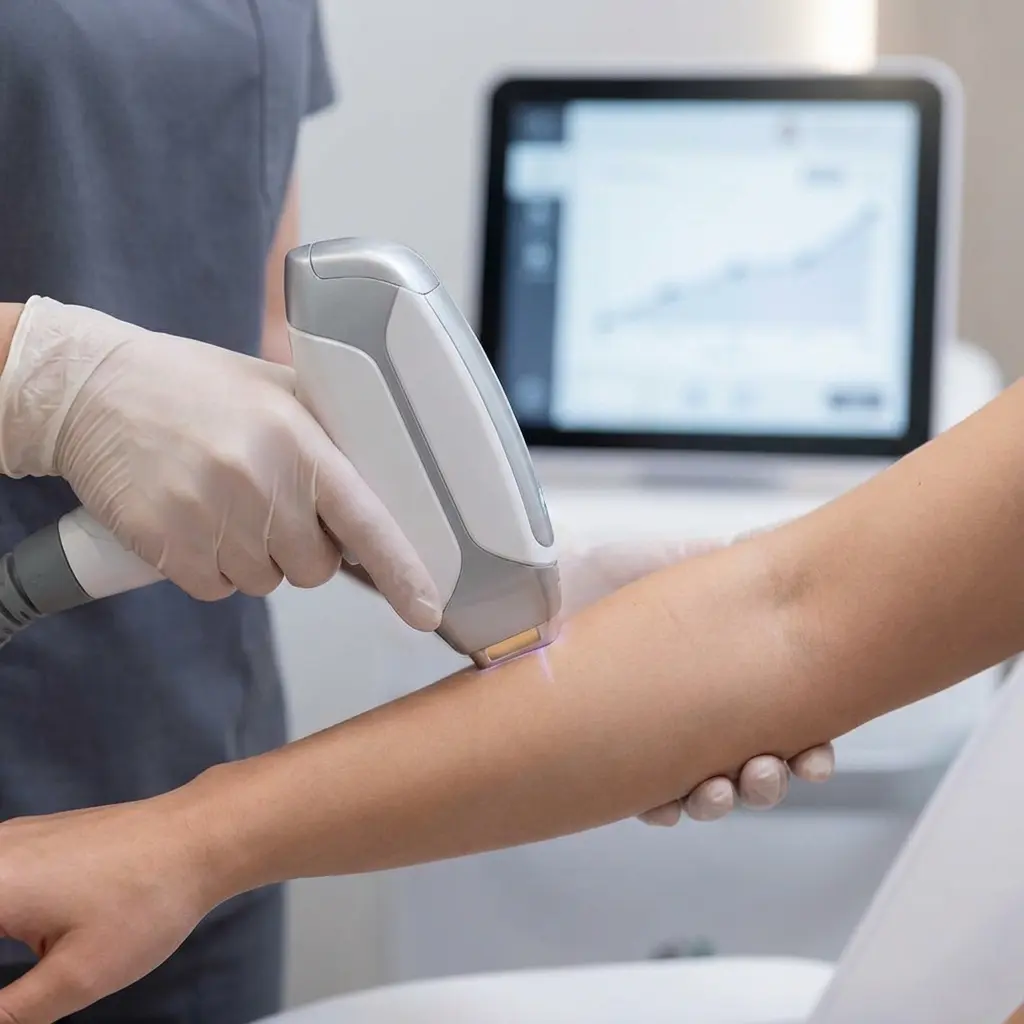
TL;DR: The UK laser hair removal market reached £93.2 million in 2023 and is growing at 17.2% annually through 2030. Clinical studies show 90% hair reduction with professional treatments. London leads in spending at £289 annually per consumer. Male treatments increased 86% between 2012-2013. The technology now works across diverse skin tones and hair types.
Core Facts:
- UK market value: £93.2 million (2023), projected to double by 2030
- Effectiveness: 90% hair reduction achievable with complete treatment series
- Treatment completion: 74% of patients achieve 75-100% hair clearance (948-patient study over 3.9 years)
- Cost advantage: Laser treatment total cost compares favorably to lifetime waxing expenses
- Demographics: 40% of women experience unwanted hair growth; male treatments up 86% in one year
What Is Driving the £93 Million UK Laser Hair Removal Market?

We’ve been tracking something remarkable in the UK beauty sector.
The laser hair removal market reached £93.2 million in 2023 with a projected compound annual growth rate of 17.2% through 2030. This represents one of the fastest-growing segments in British beauty.
The numbers reveal fundamental shifts in how consumers approach personal care, what drives treatment decisions, and where the industry is heading next.
Who Is Getting Laser Hair Removal in the UK?
Male clients in London clinics increased their laser hair removal treatments by 86% between 2012 and 2013.
That single data point changed how we understood the market because it revealed demand beyond the traditional customer base.
The traditional demographic profile—women aged 25-45 seeking leg and underarm treatments—still dominates. However, expansion into male clientele, younger consumers, and previously underserved areas creates new demand patterns.
London consumers spend £289 annually on beauty products and services, 14% above the European average and significantly higher than the UK national average of £207. This concentration of spending power in metropolitan areas like London and Essex creates favorable conditions for premium aesthetic treatments.
Approximately 40% of women experience unwanted hair growth due to normal variations, medication side effects, or underlying conditions. Therefore, the addressable market extends beyond aesthetic preferences into medical and psychological wellbeing.
Quick Insight: Demographics are expanding rapidly—male treatments jumped 86% in one year, and 40% of women experience unwanted hair growth, making the potential market far larger than traditional estimates suggested.
How Effective Is Laser Hair Removal?

Consumers achieve 90% hair growth reduction with professional laser treatments.
That number matters because it separates temporary solutions from permanent results. Laser hair removal delivers sustained reduction, whereas waxing and shaving require ongoing time and expense.
Recent clinical studies provide more granular insights:
- Single treatment reduction: 10-40% hair reduction in ideal candidates
- Three treatment reduction: 30-70% sustained reduction
- Complete treatment series: Up to 90% reduction lasting 12+ months
A comprehensive two-center study tracked 948 patients over an average of 3.9 years. Results showed 74% achieved 75-100% hair clearance as reported by physicians, with sustained results over the long-term follow-up period.
Effectiveness varies by laser type and treatment area:
- Alexandrite lasers: 35% to 84.25% long-term reduction
- Diode lasers: 32.5% to 69.2% long-term reduction
- Best treatment area: Leg hair produces greatest long-term reduction across all laser types
Does Laser Hair Removal Hurt?
Patient comfort influences treatment completion rates.
Clinical data shows patients report average pain scores of 2 out of 4 during laser irradiation. This represents “slight discomfort” rather than significant pain. In contrast, the tolerability profile exceeds traditional methods like waxing or epilating, which contributes to higher treatment completion rates.
When patients complete their full treatment series, they achieve better outcomes because the comfort factor directly impacts adherence to the protocol.
Bottom Line: Clinical studies prove 90% hair reduction is achievable, with 74% of patients reaching 75-100% clearance. Pain levels average 2 out of 4 (slight discomfort), making treatment more tolerable than waxing.
Why Is the Market Growing Despite Economic Pressures?
The UK beauty industry contributed £13.5 billion in direct GDP during 2025, growing 11% year-over-year despite broader economic pressures.
This growth pattern reveals the “lipstick effect.”
When consumers face financial constraints, they reduce spending on major purchases but maintain or increase spending on smaller indulgences. Beauty treatments fall into this category. Therefore, real-term spending on beauty and personal care products has grown even as other discretionary spending declined.
The laser hair removal market benefits from this dynamic in two ways:
First, consumers view permanent hair removal as a long-term investment rather than a recurring expense. The total cost of laser treatments compares favorably to lifetime waxing costs, creating a value-based purchasing decision.
Second, the treatment delivers both aesthetic and practical benefits. Consumers save time, reduce ongoing expenses, and achieve confidence improvements that extend beyond simple appearance.
How Is Digital Commerce Changing the Market?
Digital sales will reach 56.3% of total beauty revenue in the UK by 2025—the highest percentage in Europe.
Social commerce alone generates £2.3 billion annually in the UK beauty sector.
This digital transformation changes how consumers discover, research, and book aesthetic treatments. Online reviews, before-and-after documentation, and transparent pricing reduce barriers to entry for cosmetic procedures.
Clinics that optimize their digital presence capture a disproportionate share of new client inquiries because the research phase happens online, even when the treatment occurs in person.
Key Finding: The UK beauty industry grew 11% year-over-year to £13.5 billion despite economic pressures, driven by the “lipstick effect” and digital commerce, which will reach 56.3% of total beauty revenue by 2025.
What Do Global Trends Tell Us About the UK Market?
The global laser hair removal market will reach $7.67 billion by 2035, growing at 18.3% annually.
This global trajectory validates UK market dynamics. Growth drivers remain consistent across markets: technological advancement, increasing acceptance of aesthetic procedures, and expanding demographic reach.
In the United States, laser hair removal ranks among the top five most popular non-surgical procedures. Approximately 757,800 procedures were performed in 2020, with 84% conducted on female patients. These numbers held steady despite pandemic-related economic disruption, demonstrating the treatment’s resilience as a consumer priority.
What Technology Advances Are Expanding Treatment Options?
Recent advances in laser technology address previous limitations.
A clinical study combining Nd:YAG, diode, and Alexandrite lasers in a rotational regimen achieved 75.07% hair reduction at six months. The combination approach also increased fine vellus hair production and reduced hair thickness more effectively than single-laser protocols.
This matters because it expands the range of skin tones and hair types that respond well to treatment. Earlier laser systems worked best on fair skin with dark hair. In contrast, modern multi-wavelength approaches achieve results across broader demographic groups.
The safety profile improves with each technological generation. Adverse events remain minimal, and treatment protocols continue to optimize for both effectiveness and patient comfort.
Global Perspective: The worldwide market will reach $7.67 billion by 2035 (18.3% annual growth). Multi-wavelength laser technology now achieves 75% hair reduction and works across diverse skin tones, expanding the addressable market significantly.
Where Is Demand Highest in the UK?
London’s beauty spending exceeds the national average by 39%.
This concentration creates opportunities for clinics serving the London and Essex markets because the demographic profile skews younger, more diverse, and more willing to invest in aesthetic treatments compared to other UK regions.
Essex borders London and shares many of the same demographic characteristics while maintaining slightly lower operating costs. This geographic positioning allows clinics to serve both markets effectively.
Commuter patterns between Essex and London mean potential clients often research treatments online during their commute and book appointments near either home or workplace. Geographic convenience influences booking decisions, but quality and reputation drive initial consideration.
When Should You Start Treatment?
Treatment inquiries spike in January and February as consumers plan for summer.
However, the most successful treatment outcomes require starting earlier. A complete laser hair removal series typically spans 6-8 sessions over several months. Therefore, clients who begin treatment in autumn achieve optimal results by the following summer.
This planning cycle creates an educational opportunity because understanding the treatment timeline helps clients make better decisions about when to start.
Regional Insight: London leads UK beauty spending at £289 annually (39% above national average). Treatment inquiries spike in January-February, but optimal results require starting 6-8 months before target date (autumn start for summer results).
What Should You Consider Before Getting Treatment?

The data reveals several clear patterns for consumers considering laser hair removal:
Effectiveness is proven. Clinical studies consistently demonstrate significant, long-term hair reduction across multiple laser types and treatment areas. The question is not whether the treatment works, but which approach optimizes results for your specific situation.
The market is maturing. Rapid growth and technological advancement create better treatment options at increasingly competitive prices. As the market expands, quality providers differentiate themselves through expertise, equipment quality, and patient outcomes.
Demographics are expanding. If you previously thought laser hair removal wasn’t for you based on gender, age, or skin tone, recent technological advances may have changed the equation.
Economic value improves over time. The upfront cost of laser treatments compares favorably to the lifetime expense of temporary hair removal methods. Time savings and convenience add additional value beyond the financial calculation.
How Do You Choose a Quality Provider?
Not all laser hair removal providers deliver equivalent results.
Technology, operator expertise, and treatment protocols vary significantly across clinics. When you research providers, focus on these factors:
- Laser equipment type and maintenance schedules
- Operator training and certification
- Treatment customization based on your skin tone and hair type
- Realistic outcome expectations and timeline
- Comprehensive consultation process
- Before-and-after documentation of actual patients
Market growth attracts new providers at varying quality levels. Therefore, your results depend heavily on choosing a clinic that prioritizes patient outcomes over volume.
Decision Framework: Proven effectiveness across all laser types, expanding demographics (now including more men and diverse skin tones), and favorable lifetime cost economics make laser hair removal a sound investment—if you choose a quality provider with appropriate technology.
What Does the Future Hold for This Market?
The 17.2% compound annual growth rate through 2030 suggests the UK market will more than double from current levels.
Several factors support this projection:
Technological accessibility increases. As equipment costs decline and treatment protocols improve, more clinics enter the market. This expansion improves geographic accessibility and creates competitive pricing pressure.
Social acceptance grows. Aesthetic treatments continue their transition from luxury services to mainstream personal care. The stigma that once surrounded cosmetic procedures diminishes with each generation.
Male market expansion accelerates. The 86% increase in male treatments represents early adoption in a demographic that historically avoided aesthetic services. As social acceptance increases, this segment shows significant growth potential.
Medical applications expand. Beyond aesthetic preferences, laser hair removal addresses medical conditions like hirsutism and provides relief for individuals with chronic skin irritation from traditional hair removal methods.
What Are Your Next Steps?
You now understand the market dynamics that most consumers miss.
The UK laser hair removal sector is experiencing rapid growth driven by proven clinical effectiveness, expanding demographics, and favorable economic positioning. The treatment delivers measurable results that justify the investment for appropriate candidates.
Your decision comes down to three questions:
- Does your hair type and skin tone respond well to laser treatment?
- Can you commit to the full treatment series for optimal results?
- Have you identified a qualified provider with appropriate technology and expertise?
If you answer yes to all three, the data suggests laser hair removal delivers significant long-term value compared to temporary alternatives.
The market will continue growing. The technology will continue improving. Therefore, the question is whether you want to benefit from current capabilities or wait for future developments.
Market Outlook: The UK market will more than double by 2030 (17.2% annual growth) driven by increasing technological accessibility, growing social acceptance, male market expansion (86% increase already recorded), and expanding medical applications beyond aesthetics.
For those in London and Essex considering laser hair removal, Shumailas offers comprehensive consultations to assess your specific situation and determine the optimal treatment approach. The consultation process helps you understand realistic outcomes, treatment timelines, and total investment before making any commitment.
The data tells you what’s happening in the market. Your consultation tells you what’s possible for your specific situation.
Both pieces of information matter.
Frequently Asked Questions
How much does laser hair removal cost in the UK?
While prices vary by clinic, treatment area, and session count, the total cost of a complete laser hair removal series (6-8 sessions) compares favorably to the lifetime expense of waxing. London clinics may charge premium rates, but consumers in this region spend £289 annually on beauty services, 39% above the national average.
How many laser hair removal sessions do you need?
A complete treatment series typically requires 6-8 sessions over several months. Clinical studies show single treatments achieve 10-40% reduction, three treatments achieve 30-70% reduction, and complete series achieve up to 90% reduction lasting 12+ months.
Does laser hair removal work on all skin tones?
Modern multi-wavelength laser technology has expanded treatment effectiveness across diverse skin tones. Earlier systems worked best on fair skin with dark hair. Current approaches combining Nd:YAG, diode, and Alexandrite lasers achieve 75% hair reduction across broader demographic groups.
Is laser hair removal permanent?
Laser hair removal delivers long-term reduction rather than absolute permanence. Clinical studies show 74% of patients achieve 75-100% hair clearance, with sustained results over multi-year follow-up periods. Maintenance sessions may be needed, but the reduction is significant and long-lasting.
When should I start laser hair removal treatment?
Start treatment 6-8 months before your target date. Clients who begin in autumn achieve optimal results by the following summer. While inquiries spike in January-February, starting earlier ensures you complete the full treatment series before peak season.
Does laser hair removal hurt more than waxing?
No. Clinical data shows patients report average pain scores of 2 out of 4 (slight discomfort) during laser treatment. This tolerability profile exceeds waxing or epilating, which contributes to higher treatment completion rates and better outcomes.
What’s the difference between Alexandrite and Diode lasers?
Alexandrite lasers show 35% to 84.25% long-term hair reduction, while Diode lasers demonstrate 32.5% to 69.2% reduction. Effectiveness varies by treatment area and individual characteristics. Quality clinics customize laser selection based on your skin tone and hair type.
Why is the male laser hair removal market growing so fast?
Male clients in London increased treatments by 86% between 2012-2013. This growth reflects decreasing stigma around male aesthetic services, increasing social acceptance, and expanding awareness that laser hair removal addresses practical concerns (chronic skin irritation, athletic performance) beyond aesthetics.
Key Takeaways
- The UK laser hair removal market reached £93.2 million in 2023 and is growing at 17.2% annually, making it one of the fastest-growing segments in British beauty.
- Clinical effectiveness is proven: 90% hair reduction is achievable, with 74% of patients reaching 75-100% clearance in long-term studies.
- Demographics are expanding rapidly—male treatments jumped 86% in one year, and modern technology now works across diverse skin tones and hair types.
- The total cost compares favorably to lifetime waxing expenses, with added benefits of time savings and reduced skin irritation.
- London leads UK demand with £289 annual beauty spending per consumer (39% above national average), creating strong market conditions for quality providers.
- Treatment requires 6-8 sessions over several months—start in autumn for optimal summer results.
- Provider selection matters significantly: technology type, operator expertise, and treatment customization directly impact your results.