

TL;DR: Most topical hair products cannot reach the hair follicle stem cells responsible for regrowth because they penetrate only 10-15% of follicle depth. Hair follicles extend 2-4 millimetres deep, whilst even advanced formulations reach only 235-299 micrometres. Treatments that actually work at the cellular level—such as low-level laser therapy (LLLT) and microneedling—use mechanisms that bypass the penetration barrier entirely.
- Hair follicle stem cells live in the bulge region, 2-4 millimetres deep in your scalp
- Topical products penetrate only 235-299 micrometres (10-15% of follicle depth)
- Hair loss occurs when stem cells become dormant, not when follicles die
- Evidence-based treatments that reach stem cells: LLLT, microneedling, and systemic treatments
- 40% of women experience hair loss before age 50; early intervention improves outcomes
We spent three months investigating why women with thinning hair keep buying expensive topical treatments that promise follicle regeneration.
The research led us to an uncomfortable conclusion.
Most of what we apply to our scalps never reaches the cellular structures responsible for hair growth. The beauty industry has built a billion-pound market on a fundamental misunderstanding of skin penetration depth.
Here’s what we found.
Why Can’t Topical Products Reach Hair Follicles?

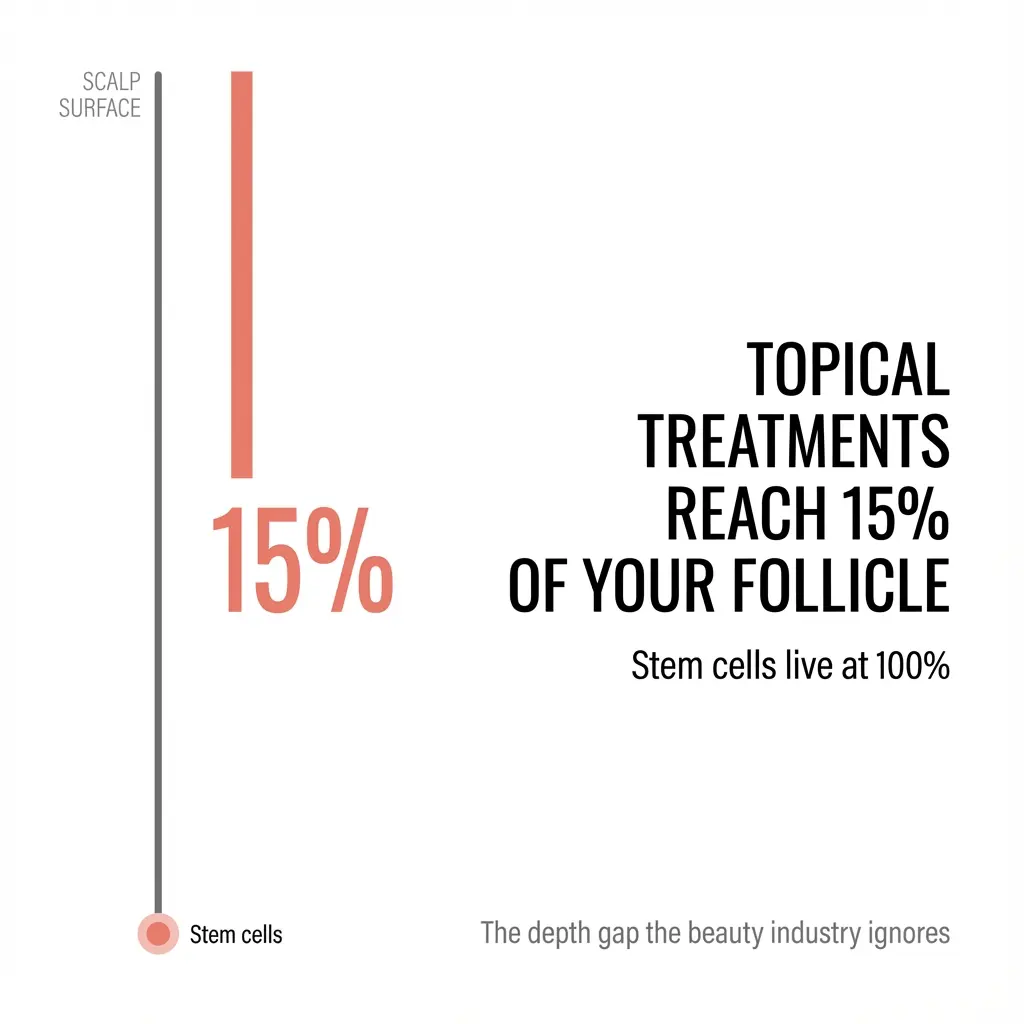
Human hair follicles extend 2-4 millimeters deep into your scalp.
Even the most advanced nanoparticle formulations penetrate only 235-299 micrometers into follicles. That’s roughly 10-15% of the total follicle depth.
The math doesn’t work in favor of topical products.
Your hair follicle stem cells live in a region called the bulge, located in the lower portion of the follicle. These stem cells control whether your follicle produces new hair or remains dormant.
When you apply a serum or treatment to your scalp, it encounters multiple barriers. Dry sebum and cellular debris block the follicle opening. The product that does penetrate reaches only the superficial portion of the follicle structure.
It never gets close to the stem cells.
The Bottom Line: Hair follicles extend 2-4 millimetres deep, but topical products penetrate only 235-299 micrometres—meaning they reach less than 15% of the follicle depth where stem cells reside.
What Actually Happens During Hair Loss?

We used to think hair loss meant the follicle died.
The research shows something different.
In hair loss scalps, stem cell numbers remain unchanged. The follicle doesn’t disappear. It becomes dormant because the progenitor cells that multiply and create new hair significantly decrease.
Your hair follicle stem cells get stuck. They stop activating new growth cycles due to age, genetics, hormones, and environmental stress.
The follicle is still there. It just won’t wake up.
This matters because it means the potential for regrowth exists. But you need to reach those dormant stem cells to reactivate them.
Surface treatments can’t do that.
Key Insight: Hair loss doesn’t mean follicles die. Stem cells remain present but become dormant because progenitor cells decrease. Therefore, the potential for regrowth exists if you can reach and reactivate those stem cells.
Are “Stem Cell” Hair Products Legitimate?
The American Hair Loss Association issued a warning about treatments marketed as “stem cell therapy” for hair loss.
Many are misleading or fraudulent.
Providers rebrand platelet-rich plasma (PRP) as “stem cell” therapy. PRP may offer modest benefits for certain patients, but it doesn’t contain stem cells. It’s not regenerative cell therapy.
The terminology confusion creates false expectations.
We see women spending thousands on treatments they believe will regenerate follicles at a cellular level. The science doesn’t support these claims for most topical or injectable products currently marketed to consumers.
Reality Check: The American Hair Loss Association warns that many “stem cell” products are misleading or fraudulent. Most are rebranded PRP treatments that don’t contain actual stem cells or provide regenerative cell therapy.
What Treatments Actually Reach Follicle Stem Cells?
After reviewing clinical studies, we found two approaches with documented efficacy at the cellular level.
Low-Level Laser Therapy (LLLT)
Low-level laser therapy (LLLT) uses specific wavelengths of light that penetrate tissue without heat damage. The mechanism works by stimulating epidermal stem cells in the hair follicle bulge and shifting follicles into active growth phase.
Every clinical trial we reviewed found significant increases in terminal hair counts, hair growth, and coverage in treatment groups. The FDA has cleared LLLT devices for both male and female pattern hair loss.
The treatment works for patients who didn’t respond to or couldn’t tolerate standard medications.
Microneedling
Microneedling creates controlled micro-injuries that trigger wound healing responses. This activates dormant follicles through increased platelet-derived growth factor, epidermal growth factors, and bulge activation.
The research shows overexpression of Wnt proteins after microneedling. These proteins play a role in hair follicle development and cycling.
Clinical evidence:
- In one study, three of four men regrew over 75% of their lost hair when microneedling was combined with topical minoxidil
- Results lasted at least 18 months after treatment ended
- Another study found 80% of participants experienced a 50% increase in hair density
Evidence Summary: Both LLLT and microneedling have FDA clearance or strong clinical evidence. In contrast to topical products, these treatments bypass the penetration barrier by using light wavelengths or mechanical injury to reach stem cells directly.

Why Does This Matter for Women?
The statistics on female hair loss surprise most people:
- 40% of women experience hair loss or thinning before age 50
- By age 65, 75% of women show signs of androgenetic alopecia
The emotional impact is significant. Hair loss affects self-image, confidence, and social interactions differently for women than men.
Yet most women we speak with try topical products first. They spend months or years applying serums, oils, and treatments that can’t reach the cellular structures responsible for regrowth.
The delay matters.
Hair follicles that remain dormant for extended periods become harder to reactivate. Therefore, early intervention with treatments that actually reach stem cells improves outcomes.
Why It Matters: Most women try topical products first and lose months or years whilst follicles remain dormant. Because dormant follicles become harder to reactivate over time, delayed intervention with effective treatments reduces regrowth potential.
Why Can’t We Formulate Better Topical Products?
Hair follicles occupy less than 0.1% of total skin area.
Even when a topical product successfully enters a follicle opening, it faces physical barriers. The follicle isn’t an open tube waiting to absorb whatever you apply.
Specialised liposomes designed for follicular delivery achieve about 70% penetration of the full follicle length. That still falls short of the bulge region where stem cells reside.
You can’t formulate your way around anatomy.
The follicle depth and stem cell location create inherent limitations for topical delivery. This isn’t a problem better chemistry can solve.
The Physics Problem: Even specialised liposomes achieve only 70% penetration of full follicle length. You cannot formulate your way around anatomy—the physical barrier is insurmountable for topical delivery.
What Treatments Actually Work for Hair Restoration?
We don’t dismiss topical treatments entirely.
Minoxidil has documented efficacy for maintaining existing hair. Some topical treatments improve scalp health, which supports overall hair quality.
But we’re direct about what these products can and cannot do.
If your goal is follicle regeneration and reactivation of dormant stem cells, topical products won’t get you there. The penetration depth doesn’t match the biological requirement.
Treatments that work at the cellular level require different approaches:
- Light-based therapies that penetrate tissue to reach stem cell regions
- Mechanical stimulation through controlled injury that triggers growth factor release
- Systemic treatments that work through your bloodstream rather than topical application
These aren’t as convenient as applying a serum before bed.
They require in-clinic visits or dedicated at-home devices. They take time and consistency.
But they address the actual problem instead of treating the surface.
Treatment Hierarchy: Topical minoxidil maintains existing hair. For follicle regeneration and stem cell reactivation, you need treatments that reach the bulge region: light-based therapies, mechanical stimulation, or systemic treatments delivered through your bloodstream.
The One Question to Ask Before Buying Hair Products
Before buying your next hair treatment, ask one question:
Can this reach my follicle stem cells?
If the answer involves topical application of a serum, oil, or cream, the answer is no.
If the answer involves light therapy, microneedling, or systemic treatment, it’s worth investigating further.
The beauty industry profits from the gap between what sounds scientifically plausible and what actually works at a cellular level. Stem cell marketing language makes topical products sound more advanced than they are.
Your hair follicles are deeper than most products can reach.
Understanding this changes how you approach hair restoration. It shifts focus from what you apply to your scalp to what actually reaches the biological structures responsible for hair growth.
That’s where real regrowth begins.
Frequently Asked Questions
Can any topical product reach hair follicle stem cells?
No. Hair follicle stem cells reside in the bulge region, 2-4 millimetres deep in your scalp. Even the most advanced nanoparticle formulations penetrate only 235-299 micrometres—roughly 10-15% of total follicle depth. The physical barrier is insurmountable for topical delivery.
Do hair follicles die during hair loss?
No. In hair loss, stem cell numbers remain unchanged. The follicle becomes dormant because progenitor cells that multiply and create new hair decrease significantly. The follicle is still present but won’t activate new growth cycles due to age, genetics, hormones, and environmental stress.
What’s the difference between PRP and actual stem cell therapy?
Platelet-rich plasma (PRP) does not contain stem cells and is not regenerative cell therapy, despite being marketed as “stem cell” treatment. The American Hair Loss Association has warned that many providers rebrand PRP to create false expectations about cellular regeneration.
How effective is low-level laser therapy for women’s hair loss?
Clinical trials show significant increases in terminal hair counts, hair growth, and coverage with LLLT. The FDA has cleared LLLT devices for both male and female pattern hair loss. It works for patients who didn’t respond to or couldn’t tolerate standard medications because it penetrates tissue to stimulate stem cells directly.
Does microneedling work for hair regrowth?
Yes. Clinical studies show that 80% of participants experienced a 50% increase in hair density with microneedling. When combined with topical minoxidil, three of four men regrew over 75% of their lost hair, with results lasting at least 18 months after treatment ended.
Why does early intervention matter for hair loss?
Hair follicles that remain dormant for extended periods become harder to reactivate. Most women spend months or years trying topical products that can’t reach stem cells, allowing follicles to remain dormant longer. Early intervention with treatments that actually reach stem cells improves regrowth outcomes.
Can better chemistry solve the penetration problem?
No. The penetration barrier is physical, not chemical. Specialised liposomes designed for follicular delivery achieve only 70% penetration of full follicle length, still falling short of the bulge region where stem cells reside. Follicle depth and stem cell location create inherent limitations that formulation cannot overcome.
What treatments should I consider instead of topical products?
For follicle regeneration and stem cell reactivation, consider treatments that bypass the penetration barrier: low-level laser therapy (LLLT) that penetrates tissue with light wavelengths, microneedling that triggers growth factor release through controlled injury, or systemic treatments delivered through your bloodstream. These require in-clinic visits or dedicated devices but address the actual biological problem.
Key Takeaways
- Penetration depth matters: Hair follicle stem cells reside 2-4 millimetres deep, but topical products reach only 235-299 micrometres (10-15% of follicle depth).
- Follicles don’t die: Hair loss occurs when stem cells become dormant, not when follicles disappear. The potential for regrowth exists if you can reach those stem cells.
- Marketing misleads: “Stem cell” products are often rebranded PRP or topical formulations that cannot deliver on regeneration promises.
- Evidence-based treatments exist: LLLT and microneedling have clinical evidence and FDA clearance because they bypass the penetration barrier entirely.
- Time is critical: 40% of women experience hair loss before age 50. Dormant follicles become harder to reactivate over time, making early intervention with effective treatments essential.
- Chemistry cannot solve anatomy: The physical barrier is insurmountable. You cannot formulate your way to stem cell penetration with topical products.
- Ask the right question: Before buying any hair treatment, ask “Can this reach my follicle stem cells?” If it’s topical, the answer is no.