


Look. Feel. Live. Better
Facial Scar Revision Surgery
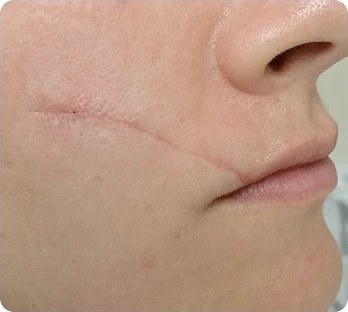
| Details |
|---|
| Surgery Time |
| Return to Work |
| Full Recovery |
| Anaesthesia |
| Location |
| Information |
|---|
| 1 - 2 hours |
| 3 - 5 days |
| 4 - 6 weeks |
| Local Anaesthetic |
| London, Essex, Hertfordshire |
Happy Customer Reviews

Certified & Experienced Doctors

Safe and Surgically Proven
Facial Scar Revision Surgery is a well-established procedure when performed by qualified surgeons under UK clinical governance.
At Shumaila’s London, all procedures are delivered by GMC-registered surgeons in CQC-registered environments, with individualised consent and aftercare.
It’s safe because
And effective, due to:
Excellent 4.9 out of 5


Experts Guaranteed
Shumaila’s world class team of doctors span from the UK to Eruope

Clinics
10+
Experts
10+
Experience
35+ years


Expect results in
Weeks 1–2 (Initial Healing)
The primary goal is secure wound closure. Expect a fine, pink incision line once sutures are removed. The area must be protected from stretching and sun exposure.
Weeks 3–4 (Active Repair)
The new scar tissue is forming. It is normal for the line to look slightly redder or feel firmer during this phase. Consistent use of silicone gel is crucial here.
Months 2–3 (Maturation Begins)
The redness starts to slowly dissipate. If you are prone to hypertrophic scarring, your surgeon may recommend a steroid injection during this period to keep the scar flat.
Months 3–6 (Softening & Fading)
The collagen fibres reorganise, causing the scar to soften significantly and fade toward your natural skin colour. The geometric benefits of techniques like Z-plasty become apparent as the scar blends into facial contours.
Year 1+ (Final Result)
The scar reaches full maturity. While no scar can be completely erased, the revised scar will be a fine, flat, pale line that is vastly less noticeable than the original blemish.
Ready to start?
Choose Shumaila’s
Watch our video
Post-Operative Aftercare
Proper aftercare is just as important as the surgery itself in determining the final appearance of your scar. Follow these UK clinical guidelines:
Frequent Asked Questions
No surgical procedure can completely erase a scar. The goal of facial scar revision is to replace a highly visible, raised, or poorly aligned scar with a much finer, flatter line that blends naturally into your skin’s tension lines, making it significantly less noticeable.
In line with UK plastic surgery guidelines, we strongly advise waiting at least 12 months after the initial injury or surgery. Scars undergo a natural remodelling phase during this time, often fading and flattening on their own. Revising an immature scar can lead to worse results.
A hypertrophic scar is raised and red but stays strictly within the boundary of the original wound. A keloid scar grows beyond the original wound into healthy surrounding skin. Keloids are more complex to treat and often require a combination of surgery and steroid injections.
Most facial scar revisions are performed as day-case procedures under local anaesthetic, meaning you are awake but feel no pain. For larger or more complex revisions, local anaesthetic with sedation or total intravenous anaesthesia (TIVA) may be recommended by your surgeon.
You must wait until the wound is fully closed and the sutures have been removed or dissolved, which typically takes 7 to 10 days. Once your surgeon confirms the incision is sealed, you can apply makeup or specialist skin camouflage to conceal any residual redness.
Yes. Deep, pitted acne scars (such as “ice pick” or “boxcar” scars) that do not respond to laser or microneedling can be individually excised using a punch excision technique. The tiny resulting wound is closed with a single fine stitch, leaving a much smoother surface.